
Cybersecurity in Your Pocket: MTN & ESET

The contemporary smartphone is no longer a mere communication utility.

It has evolved into a primary financial terminal, our decentralized workplace, and the literal repository of digital identities. These devices are carried with an intimacy we accord no other technology, treating them as trusted extensions of our daily lives. There was a time when cybersecurity was primarily an organizational concern.
It belonged to IT departments, security teams, and large enterprises tasked with protecting complex networks and sensitive databases. That reality has since changed.
In many ways, a smartphone is no longer just a Ddevic.e
it is a digital extension of its owner. And cybercriminals know it.
As mobile technology continues to evolve, so does the sophistication of the threats designed to exploit it. The same device that enables instant communication, seamless banking, remote work, and digital convenience has also become one of the most attractive entry points for cybercrime. To operate a smartphone without sophisticated endpoint protection is to navigate a minefield completely blind.
The Mobile Device Has Become the New Frontline
Cybersecurity discussions often focus on large-scale breaches, ransomware attacks, and nation-state actors. While these threats remain significant, a quieter transformation has been taking place in the background.
Attackers have increasingly shifted their attention toward individuals.because people are often easier to compromise than infrastructure. A firewall cannot be manipulated through urgency. A server cannot be convinced to click a fraudulent link. A security appliance cannot be socially engineered.
People can.
Modern cybercriminals understand that gaining access to a person's smartphone often provides a direct pathway to everything else that matters.
◉ Financial accounts.
◉ Business communications.
◉ Personal information.
◉ Digital identities.
◉ Corporate networks.
The smartphone has become the bridge connecting every aspect of modern life. Once that bridge is compromised, the consequences can extend far beyond the device itself.
Why Cybercriminals Are Investing More in Mobile Attacks
Cybercrime has evolved into a highly sophisticated global industry. Today’s attackers operate with business-like efficiency, leveraging automation, artificial intelligence, data analytics, and scalable attack infrastructure to maximize reach and profitability.
Mobile devices have become particularly attractive targets for several reasons.
First, users tend to place a high level of trust in their smartphones. While many people exercise caution when using desktop computers, they are often less vigilant on mobile devices, making them more susceptible to malicious links, fraudulent applications, and social engineering attacks.
In addition, smartphones are constantly connected. Unlike traditional computers that may be powered off for extended periods, mobile devices maintain continuous access to networks, applications, cloud services, and personal accounts, creating a persistent opportunity for attackers.
Furthermore, mobile devices centralize an extraordinary amount of sensitive information.
Banking applications, digital wallets, email accounts, cloud storage, authentication tools, and business communications are often accessible from a single device. This concentration of data provides cybercriminals with multiple avenues for identity theft, financial fraud, account takeover, and corporate compromise.
For cybercriminals, a successful mobile compromise can deliver significant returns, making smartphones one of the most valuable and increasingly targeted assets in today's threat landscape.
The Weaponization of Generative AI in Mobile Phishing (Smishing)
Artificial Intelligence has not only lowered the barrier to entry for cybercrime but has also increased the speed, scale, and sophistication of attacks.
Phishing emails and text messages that once contained obvious errors are now professionally crafted, highly personalized, and difficult to distinguish from legitimate communications. Fraudulent messages can convincingly mimic trusted organizations, while deepfake technology can replicate voices, images, and even video with alarming accuracy.
As a result, social engineering attacks are becoming more targeted, more persuasive, and far harder to detect. The threat landscape is shifting rapidly. Traditional warning signs are no longer as reliable, and users can no longer depend on obvious mistakes to identify a scam.

Again, the era of the easily identifiable phishing attempt marred by fractured syntax and obvious design flaws is officially dead.
Malicious actors now deploy AI engines to synthesize hyper-contextualized SMS and instant messaging campaigns (Smishing). These messages mimic banking institutions, logistics conglomerates, and government platforms with absolute fidelity. Because mobile screen geometry truncates URL bars and hides full header data, spotting a deceptive site on the move is mathematically improbable for the human eye. Modern mobile security acts as an automated, real-time cryptographic filter, neutralizing malicious domains at the network level before a user can execute a fatal click.
Zero-Click Exploits and Hostile Public Networks
The comforting myth that digital infection requires an active user mistake, such as downloading an untrusted file; has been thoroughly debunked. Modern state-sponsored and commercial threat actors routinely deploy "zero-click exploits." These are highly sophisticated payloads engineered to compromise a device silently through an unprompted system message or a hidden VoIP call that requires no user interaction whatsoever.
Simultaneously, our systemic reliance on public Wi-Fi infrastructure exposes unencrypted data streams to "Man-in-the-Middle" (MitM) interceptions. Enterprise-grade mobile protection functions as an active, persistent shield—intercepting anomalous traffic, enforcing immediate data encryption, and conducting deep-file integrity checks to stop quiet infiltrations.
Also, Mobile application ecosystems continue to expand rapidly.
While most applications are legitimate, malicious software often disguises itself as useful tools, productivity applications, games, or utility services.
Once installed, malicious applications may collect sensitive information, monitor activity, or create backdoors for future attacks.
The Asymmetric Threat of BYOD Infrastructure
The contemporary workspace is aggressively decentralized. The modern professional manages corporate pipelines, modifies cloud-stored proprietary files, and sanctions internal operations directly from a personal mobile device.
This shifts your smartphone from a personal tool into a high-value backdoor into your organization's entire enterprise architecture. A single credential-harvesting script or malicious application on a personal handset allows hackers to pivot laterally into corporate servers.
Securing your pocket is no longer just about personal privacy; it is a matter of professional survival, data compliance, and protecting organizational assets.
The Architecture of Minimalist Defense
A common misconception is that robust mobile protection compromises device performance. Modern security frameworks are engineered for high-efficiency, lightweight execution, operating silently within the kernel layer without inducing battery degradation or processing latency.
Operating an unprotected smartphone is the structural equivalent of securing your vault door while leaving the ground-floor windows wide open. Your data, your liquid assets, and your digital footprint deserve elite defense. It is time to apply the same strategic urgency to your pocket that you demand for your servers because the ultimate perimeter is already in your hand.

The ESET N3,700 Solution
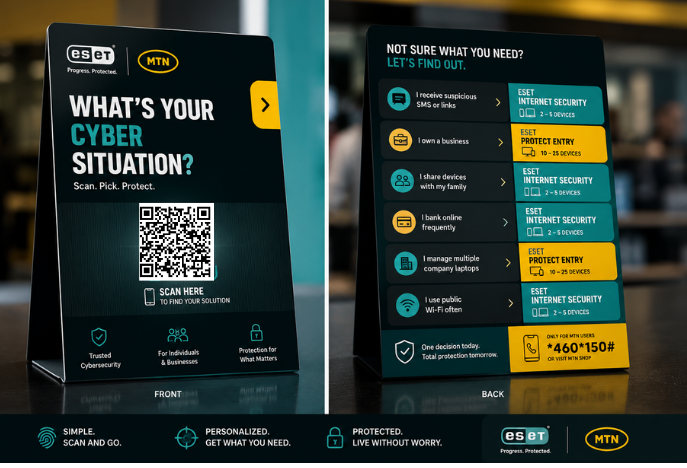
The ESET mobile and laptop security solution, offered in partnership with MTN, provides robust digital protection tailored for maximum performance without system slowdowns. Starting from just ₦3,700, users receive a comprehensive 30-day subscription that shields up to 2 devices simultaneously, making it an affordable, cross-platform security asset.
The solution runs silently in the background to stop viruses, block malicious network traffic, and protect sensitive personal or corporate data. Activating this lightweight, high-efficiency defense is immediate and seamless; users simply need to dial the quick USSD code *460* 150# directly from their MTN lines to secure their digital workplace on the go.



Comments